
Equity vs. Debt Financing: The Ultimate Guide for Smart Business Growth
In this comprehensive guide, we’ll break down both options in plain English. You’ll discover what they are, how they work, their real-world pros and cons, and—most importantly—how to pick the one that aligns with your goals, risk tolerance, and stage of growth. By the end, you’ll have a clear framework to make confident funding decisions that protect both your vision and your wallet.
Dr. Manu Sharma ( P.hD )
4/16/20264 min read
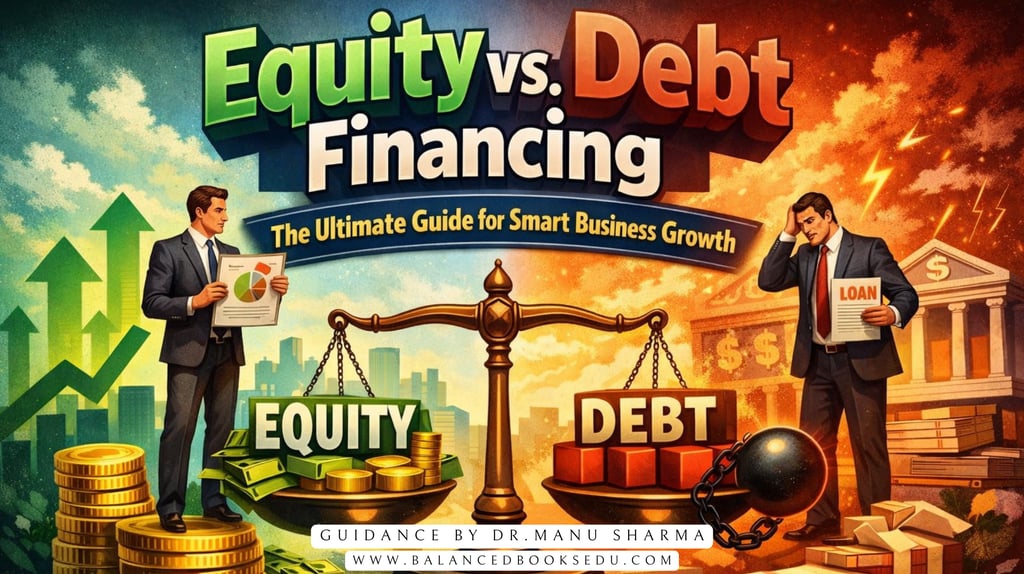
Equity vs. Debt Financing: The Ultimate Guide for Smart Business Growth
Every entrepreneur dreams of scaling their business, but turning that vision into reality often comes down to one critical decision: how to fund it. Whether you’re launching a startup, expanding an SME, or steering a mature company through its next phase, choosing between equity financing and debt financing can make or break your journey.
In this comprehensive guide, we’ll break down both options in plain English. You’ll discover what they are, how they work, their real-world pros and cons, and—most importantly—how to pick the one that aligns with your goals, risk tolerance, and stage of growth. By the end, you’ll have a clear framework to make confident funding decisions that protect both your vision and your wallet.
Let’s dive in.
What Is Debt Financing?
Debt financing is exactly what it sounds like: borrowing money that you promise to pay back—usually with interest—over a set period.
Think of it as taking a business loan from a bank, issuing corporate bonds, or drawing on a line of credit. The lender doesn’t get any ownership in your company. They simply want their principal back plus the agreed-upon interest.
Common Types of Debt Financing
Term loans from banks or NBFCs (fixed repayment schedule)
Lines of credit or revolving credit facilities
Invoice financing or factoring (using unpaid invoices as collateral)
Equipment financing or asset-backed loans
Corporate bonds (for larger, established firms)
Pros of Debt Financing
You keep 100% ownership and control — No board seats or investor vetoes.
Interest is tax-deductible — Lowers your effective cost of capital.
Predictable payments — Makes budgeting straightforward.
Faster access in many cases compared to raising equity.
Builds credit history — Successful repayment improves future borrowing terms.
Cons of Debt Financing
Repayment obligation — You must pay regardless of whether your business is profitable.
Collateral risk — Many loans require personal guarantees or assets as security.
Cash-flow pressure — Fixed EMIs can strain finances during slow periods.
Credit score dependency — Poor credit or high debt-to-equity ratio can block approval.
Interest rate risk — Floating rates can rise with market conditions.
Quick tip : Debt works best when your business has steady, predictable cash flows (think e-commerce stores, service businesses, or manufacturing with recurring orders).
What Is Equity Financing?
Equity financing means selling a portion of your company’s ownership (shares) in exchange for capital. Investors become partial owners and share in both the upside and the downside.
This is the route most venture-backed startups take—think angel investors, venture capital firms, private equity, or even an eventual IPO.
Common Types of Equity Financing
Angel investing (early-stage, high-net-worth individuals)
Venture capital (growth-stage funding rounds)
Private equity (later-stage buyouts or growth capital)
Crowdfunding equity platforms
Initial Public Offering (IPO) or direct listing (for mature companies)
Pros of Equity Financing
No repayment pressure — If the business struggles, you don’t owe investors money.
Access to expertise and networks — Smart money often comes with mentorship and introductions.
Flexibility in early stages — Ideal when cash flow is uncertain.
Higher funding amounts possible — Investors can write seven- or eight-figure checks.
Shared risk — Investors lose if the company fails.
Cons of Equity Financing
Dilution of ownership — You give up a slice of future profits and control.
Higher long-term cost — If your company becomes hugely successful, that 20% you sold could be worth millions.
Investor expectations — Board seats, reporting requirements, and pressure for rapid growth.
Time-consuming process — Pitch decks, due diligence, and negotiations can take months.
Loss of autonomy — Major decisions may need investor approval.
Quick tip : Equity shines for high-growth, capital-intensive businesses (SaaS, biotech, deep-tech) where you need large sums upfront and several years before profitability.
Equity vs. Debt Financing: Head-to-Head Comparison
Aspect
Debt Financing
Equity Financing
Ownership
Retained 100%
Diluted (investors get shares)
Repayment
Mandatory (principal + interest)
None
Cost
Interest (typically 8-18% p.a.)
Share of future profits (potentially unlimited)
Risk to Owner
Personal liability if default
Shared with investors
Tax Benefit
Interest deductible
No direct tax benefit
Speed
Usually faster
Longer due diligence
Best For
Stable cash-flow businesses
High-growth, pre-profit companies
Control
Full
Partially shared
When Should You Choose Debt vs. Equity?
There’s no one-size-fits-all answer, but here’s a practical decision framework:
Choose Debt Financing if:
Your business already generates consistent revenue.
You want to maintain full control.
You have strong credit and collateral.
Interest rates are low and manageable.
You’re funding a specific, short-to-medium-term project (e.g., new machinery).
Choose Equity Financing if:
You’re in the early or high-growth phase with uncertain cash flows.
You need a large amount of capital quickly.
You value strategic partners who bring industry expertise.
You’re comfortable sharing future success.
Traditional lenders have already said “no” due to risk profile.
Pro move : Many successful founders use a mix of both (called a “capital stack”). For example, raise a seed equity round to build the product, then layer on debt once revenue stabilizes.
Hybrid Financing Options Worth Knowing
Modern finance has blurred the lines. Consider these flexible alternatives:
Convertible notes — Starts as debt but can convert to equity later.
SAFE agreements (Simple Agreement for Future Equity) — Popular with startups.
Mezzanine financing — A hybrid of debt and equity with warrants.
Revenue-based financing — Repay as a percentage of monthly revenue.
These instruments give you the best of both worlds: less immediate pressure than pure debt and less dilution than pure equity.
Real-World Perspective
A bootstrapped restaurant chain might use bank loans (debt) to open new outlets because it has predictable daily cash sales. Meanwhile, an AI startup with a game-changing algorithm but no revenue yet will almost certainly raise equity from investors who believe in the 10x upside.
The key lesson? Match the financing to the business phase and risk profile.
Final Thoughts: Build Your Capital Strategy with Confidence
Equity and debt financing aren’t rivals—they’re tools in your toolbox. The smartest founders understand both deeply, weigh the trade-offs honestly, and build a funding roadmap that supports sustainable growth without unnecessary stress or regret.
Before signing any term sheet or loan agreement, ask yourself:
How much control am I willing to give up?
Can my business service debt comfortably?
What does success look like in 3–5 years?
Need help mapping out your perfect capital mix? Drop a comment below, share your business stage and goals, or reach out to a trusted financial advisor or fractional CFO. The right decision today can unlock decades of freedom tomorrow.
Ready to take the next step...? Visit Our Website for more practical guides on scaling, funding, and leadership. Your inbox will thank you.